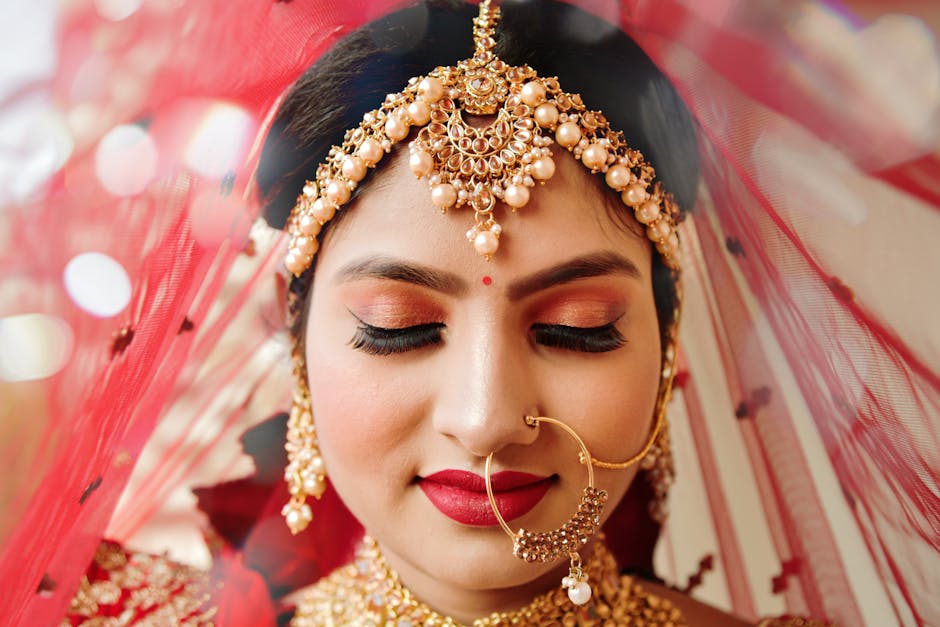
Of course, darling. Let us sculpt. Forget passing trends; we are now operating within the realm of pure form, where the principles of classical art and grand architecture become the tools for adorning the living sculpture that is your face. Consider the central column of your visage—that elegant meridian formed by your forehead and nose, intersected by the horizontal sweep of your brows—as the primary armature for our work. Upon this structure, the bindi is not mere decoration; it is the absolute point of convergence that holds the entire composition in equilibrium.
Imagine your brow bones forming a perfect Roman arch. The bindi, my dear, is the keystone. Its precise siting dictates the entire symphony of your facial harmony. A keystone positioned with anything less than masterful intention would shatter the architectural grace and structural integrity of the arch. In the same way, the bindi’s placement orchestrates the perceived strength, lift, and elegance of your foundational features. This is not embellishment; it is structural engineering.
The Vertical Axis: Sculpting with Illusion
The most potent instrument you possess for manipulating facial architecture is the vertical axis. The plane between your hairline and your brows is a space of infinite potential. By orchestrating your anchor point’s position along this meridian, you command the power to create breathtaking optical illusions.
- The Ascended Position (Nearer the Hairline): Siting the bindi higher on the forehead initiates a dramatic upward sweep, drawing the observer's gaze skyward. This masterful stroke bestows a regal aura and an illusion of length, making it a divine counterpoint to the natural width of round or square facial structures. It is a technique that sculpts an immediate impression of serene intellect, elevating the entire composition of the face.
- The Grounded Position (Just Above the Brow's Convergence): Conversely, a placement nestled closer to the threshold of the brows anchors the composition. This action compresses the vertical space to establish a powerful horizontal equilibrium, directing all visual energy toward the windows of the soul—your eyes. For those with oblong or longer visages, this positioning restores a crucial sense of balance. It creates an undeniable gravitational pull toward your gaze, a principle of a singular, potent statement we see in all great works of art.
Form and Magnitude: The Final Geometric Flourishes
Once you have mastered the art of placement, the bindi’s very form becomes your next consideration. This is not about complex filigree, but about the pure, unadulterated influence of geometry.
- Shape: The geometry of the bindi itself contributes to the narrative. An elongated form—a delicate teardrop or a spare, vertical dash—inherently amplifies the illusion of height and sophistication. It echoes and enhances an upward trajectory. A perfectly circular medallion, by contrast, is a study in unity. It functions as a gravitational center, a symbol of focus that can soften sharp angles and introduce a profound sense of calm symmetry to the face.
- Magnitude: Proportional integrity is paramount. The scale of the bindi must exist in a harmonious dialogue with your features. On a face defined by strong, prominent architecture, a diminutive accent risks being rendered silent, failing to secure its role as an anchor. Conversely, a medallion of overwhelming magnitude on a delicate facial structure creates a dissonance that disrupts the natural rhythm of the face. You must assess its scale against the weight of your brows, the aperture of your eyes, and the structure of your nose. The objective, my dear, is a sublime visual resonance, a perfect dialogue between ornament and anatomy.
Alright my darlings, let's sculpt. Forget what you think you know. We're moving beyond simple decoration and into the realm of pure, unadulterated artistry.
The Epicenter of Perception: Why Millimeters Are Monumental
Why this fanatical devotion to placement, you ask? Because, my loves, the bindi is the compositional anchor of your entire visage. It is the absolute first point of visual entry, the mark from which the viewer’s eye will embark on its journey across the canvas of you. You are, in essence, an architect drafting the blueprint for how your own face will be navigated and understood. Internalizing this truth is the fundamental difference between a woman who wears a bindi and a woman who commands it.
Let me draw a parallel from my classical art training, if I may. Think of the bindi as the vanishing point in a masterful perspective painting. Suddenly, every other line and plane of your face—the elegant sweep of the zygomatic arch, the confident line of the mandible, the delicate arc of the brows—appears to converge upon or radiate from that singular, deliberate point. By selecting its precise coordinates, you redefine the entire spatial dynamic of your face.
Sculpting with Light and Focus: A Guide to Directing the Gaze
This is the moment, my darlings, where artistic principle becomes breathtaking practice. By comprehending the bindi's power as a focal point, you gain the ability to chisel, soften, broaden, or elongate your features at will.
- To Forge an Unwavering Gaze: Positioning a bindi lower, nestled snugly at the bridge of the nose, is an act of condensation. It pulls all visual energy inward, creating a single, penetrating point of focus. The effect? A gaze that feels direct, intentional, and utterly magnetic. This is a look designed to hold a boardroom captive.
- To Architect a Sense of Openness: For a visage that is more delicate in width, or where the eyes are set closer together, a bindi with a slightly more generous circumference introduces a crucial horizontal element. It claims a larger piece of the visual plane, compelling the observer's eye to travel outward and fostering an illusion of glorious expanse across the upper third of the face.
- To Balance or Amplify Structure: Now, for the divine interplay of shapes. For a face blessed with strong, architectural lines—a defined jaw, pronounced cheekbones—a perfectly circular bindi introduces a delicious geometric contrast. The gentle curve enters into a dialogue with the sharp angles, creating a sublime visual equilibrium. Conversely, placing a sharp, angular bindi upon that same bone structure creates a powerfully chic dissonance—a high-fashion statement of intent. There is no right or wrong, only different compositional choices that define your aesthetic narrative.
At its heart, achieving mastery over bindi placement is an intimate act of self-cartography. It requires you to become a scholar of your own unique topography—to trace the peaks of your brow bone, the gentle slopes of your temples, the unique landscape of you. Once you truly see your face as your canvas, the bindi is transformed. It ceases to be an accessory and becomes your most potent instrument for sculpting perception.